Introduction to the Hadrosaurs

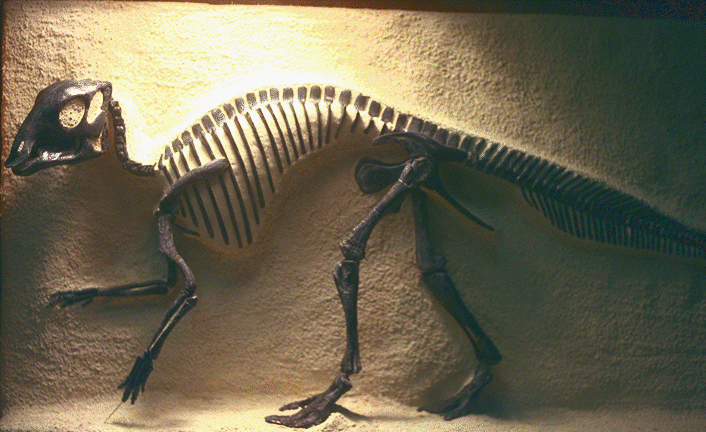
The "duckbilled dinosaurs" were common in the Upper Cretaceous of Europe, Asia, and North America. They were members of the Ornithopoda, and close relatives and possibly descendants of the earlier iguanodontid dinosaurs. Early interpretations of fossil skin impressions suggested that hadrosaur feet were webbed. Recent hypotheses, more consistent with what we know about the structure of ornithopod feet, suggest that hadrosaurs had pads similar to those seen on camel feet. Their stiff tails, supported by ossified tendons, and their sturdy bones and rapidly replaced teeth suggest that hadrosaurs spent most of their time on land, though close to bodies of water, feeding on tough terrestrial plants. The discovery of spectacularly preserved hadrosaur nests and young shows that hadrosaurs migrated to nesting grounds to reproduce.
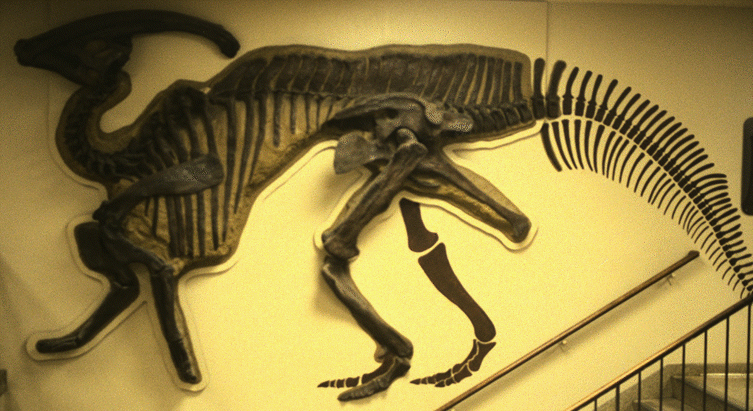
There are two subfamilies of hadrosaurs, the Lambeosaurinae, which have a crest on the skull (like the top skull at right), and the Hadrosaurinae, which lacked the crest (like the bottom skull at right). The crest on a lambeosaur's skull contains the nasal passages, which "looped" through the crest and often formed sizeable chambers before passing into the airway. Why the crest? A number of hypotheses have been seriously suggested:
The most accepted theory today of the function of the crest is that it served as a resonating chamber, allowing lambeosaurs to make deep, loud sounds. Perhaps these calls warned of predators, or kept a herd together, or attracted potential mates, or did all these things. The crest may have also functioned as a visual display device in addition: perhaps large and odd-shaped crests attracted mates.
Now let's meet some of the duckbilled dinosaurs. Both Maiasaura and Edmontosaurus are hadrosaurines; they lack the crests of the lambeosaurs.
See Parasaurolophus, a crested lambeosaur, as it was exhibited in UCMP's former home in Minor Hall.